

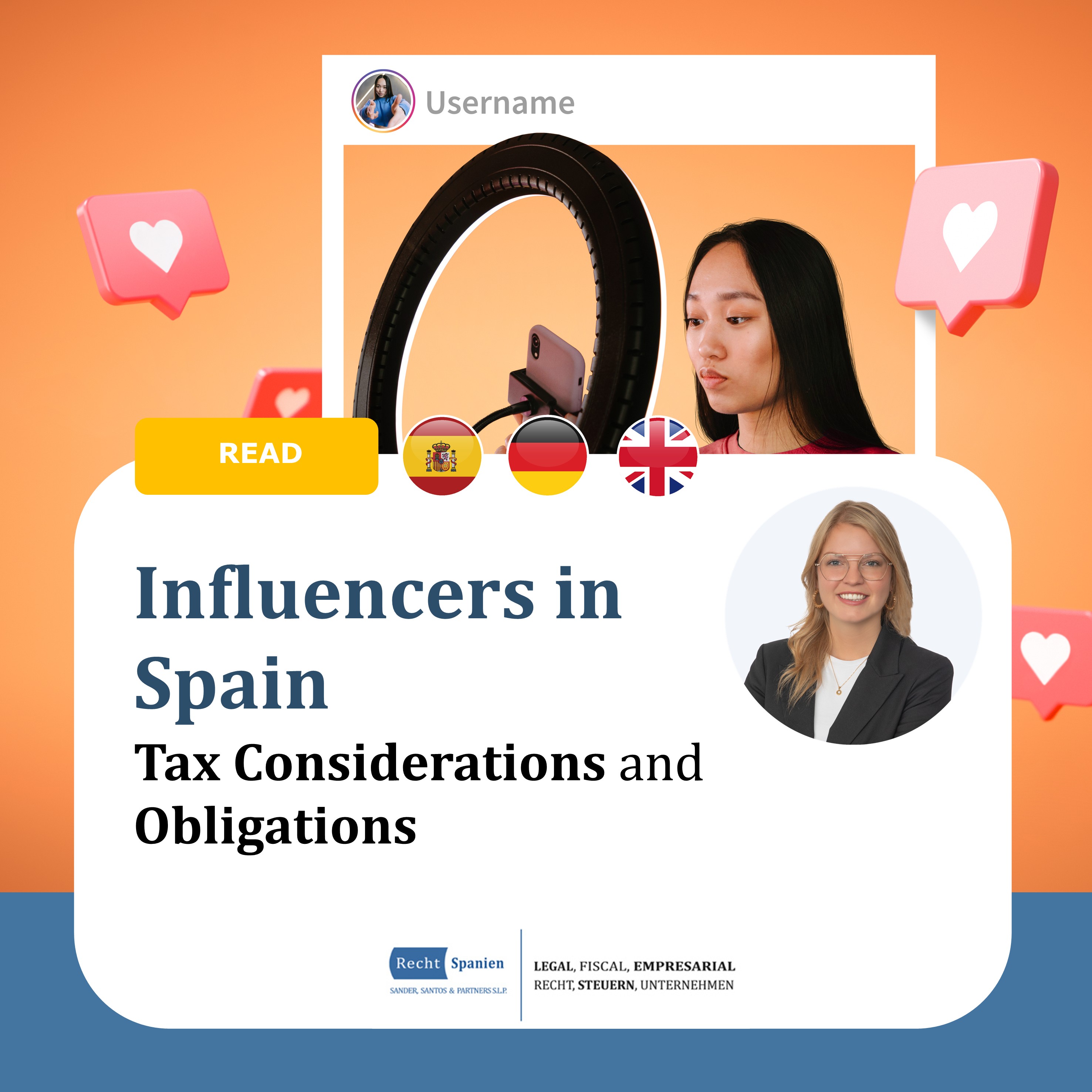
In recent years, influencer marketing has developed rapidly in Spain, not least because of the attractive lifestyle the country offers. Sunshine, beaches, Mediterranean cities and a relaxed way of life make Spain an ideal setting for lifestyle content shared daily on platforms such as Instagram, TikTok, YouTube and Twitch. Whether fashion, travel, gastronomy or fitness – many influencers take advantage of precisely these factors to create authentic content with a wide reach.
As this industry has grown, new sources of income have emerged and are becoming increasingly important, particularly for young entrepreneurs. At the same time, however, these digital business models entail tax obligations that are often underestimated. This article provides a structured and practical overview of the specific tax considerations and obligations for influencers in Spain.
Tax Classification and Registration
As a general rule, influencers in Spain are treated for tax purposes as self-employed persons (autónomos), unless they operate through a company. The decisive factor is not whether the activity is carried out on a full-time or part-time basis, but whether there is a regular and independent economic activity carried out with the intention of generating income. This is particularly the case where there are collaborations with brands, content is created systematically or income is generated. The legal basis for this is Article 27 of the Spanish Personal Income Tax Law (Ley del IRPF).
Starting the activity requires registration both with the Spanish Tax Agency (Agencia Tributaria, AEAT) and with the Spanish Social Security system (Seguridad Social, TGSS). In practice, the AEAT increasingly requires registration even where income is relatively low, provided that there is evidence of a structured economic activity.
Influencers can generate income from a wide variety of sources. In addition to traditional advertising collaborations with companies, these include affiliate marketing (commission-based income generated through tracking links and discount codes), income from platforms such as YouTube or Twitch, income from their own products (e.g. clothing, cosmetics or digital products such as courses or e-books), as well as so-called benefits in kind. The latter, in particular, can present a significant tax risk in practice.
Further information on digital services can be found in our articles: Digital Services in Spain and E-Commerce and OSS.

Benefits in Kind and Tax Risks
Benefits in kind are benefits that are not provided in cash, for example free products, trips, hotel stays or invitations to events. The decisive factor is whether these benefits are connected with the influencer's professional activity. This is particularly likely to be the case where:
- the product or service is shown, mentioned or linked in the content
- the influencer publicly discloses receipt of the product or service (e.g. “PR package”, “Gifted”, “Ad”)
- there is a recognisable expectation on the part of the brand
- the influencer regularly receives similar products from companies
- the product or service is provided in a clear professional context (e.g. sent to a business address or provided as part of a collaboration)
- service agreements or collaborations with the company already exist beforehand or at the same time
It is important to distinguish between different situations: not every benefit received automatically constitutes a taxable benefit. If there is a direct professional connection and the benefit is necessary for carrying out the activity, it may instead constitute business-related use without the character of a personal benefit. A useful practical question for making this distinction is: Would the product or service be deductible as a business expense if the influencer had paid for it themselves? If the answer is yes, this may indicate that there is no taxable benefit in kind.
Example 1 (non-taxable benefit):
A hotel invites an influencer to stay for two nights so that the influencer can produce content on site (photos, videos, reviews). The stay is directly connected with the provision of the service.
In this case, it may be argued that the stay does not constitute a traditional benefit in kind, but rather a necessary component of the professional activity.
Example 2 (taxable benefit):
An influencer receives a one-week hotel stay including accommodation for accompanying family members or is provided with a vehicle for private use without there being a clear professional need for such use.
In this case, there will generally be a taxable benefit in kind.
Where benefits in kind are provided predominantly or clearly for private purposes, or go beyond what is professionally necessary, the tax authorities will generally consider them to constitute taxable benefits. In these cases, the products or services may become taxable. This means that a proper invoice should be issued in respect of the products or services. For tax valuation purposes, the relevant amount is the market value (valor de mercado) pursuant to Article 43 of the Spanish Personal Income Tax Law (Ley del IRPF). The market value (valor de mercado) is the price that a product or service would obtain under normal market conditions between independent parties. Put simply: What would the product or service cost you if you purchased it yourself under normal market conditions?

Income and profits are subject to Spanish Personal Income Tax (IRPF). Like all other autónomos, influencers are required to make quarterly advance income tax payments using Modelo 130 and to file an annual personal income tax return.
Influencer services are generally subject to Spanish Value Added Tax (IVA). Services supplied to businesses in Spain are currently subject to VAT at 21%. For services supplied to businesses within the EU, the reverse-charge mechanism generally applies, provided that the customer has a valid EU VAT identification number. The same principle generally applies where the recipient of the service is established in a non-EU country: the place of supply is normally shifted abroad, meaning that the invoice is issued without Spanish VAT. (Link article on invoicing)
On the expense side, influencers may deduct various costs for tax purposes, provided that there is a clear professional connection. Typical deductible expenses include investments in camera and recording equipment, software subscriptions, travel expenses incurred in connection with collaborations and the cost of work equipment. As a general rule, tax deductibility in Spain requires a proper invoice (“factura”) that meets the formal requirements, including in particular full details of the supplier and customer, NIF, a description of the goods or services and the applicable VAT. Without such an invoice, the Spanish Tax Agency (AEAT) will generally not recognise the business expense deduction in practice. An exception applies to the self-employed person's own meal expenses in restaurants. Although there is not yet a clear position from the tax authorities on this point, the wording of the law appears to suggest that in these cases a receipt (“ticket”) together with proof of payment may be sufficient. Payment must not be made in cash if the expense is to be deductible. To be on the safe side, however, it is advisable to request a proper invoice in these cases as well.
In practice, the Spanish tax authorities are increasingly scrutinising this area. The most common mistakes include failing to register as an autónomo, failing to declare benefits in kind, incorrect invoicing and inadequate documentation of income and expenses. Overall, influencers in Spain are treated for tax purposes in much the same way as traditional business owners. The wide range of potential sources of income therefore also entails extensive tax obligations.
Our firm will be pleased to assist you in analysing your specific situation, carrying out the necessary administrative procedures on your behalf and preparing and filing the corresponding tax returns. If you are interested in our services or have specific questions regarding this topic, please do not hesitate to contact us by email or telephone.
Author:

Rike Füllgraf
Tax Advisor
info@sspartners.es
Tel: (+34) 951 12 13 06
Facebook I LinkedIn I Amazon
Stay informed! Follow us on:


 (+34)
(+34)