

In Spain, as a general rule, all economically active persons (employees and business owners) are required to contribute to the statutory pension and Social Security system (Seguridad Social). Although everyone contributes to the same statutory pension and Social Security system, there is an important distinction depending on the type of employment or professional relationship.
1. Standard Employment Relationship:
As a general rule, all employees who do not hold a direct or indirect interest in the company must be employed under a standard employment relationship. The employer is responsible for paying the majority of the Social Security costs, issuing payslips and handling employee administration. These employees are covered by the General Social Security Scheme (Régimen General).
2. Business Owners:
Sole traders, family members who work in the business, as well as company partners and directors who hold a certain percentage of the company's share capital, are required to register themselves under the special Social Security scheme for self-employed persons (RETA: Régimen Especial de Trabajadores Autónomos).
Before examining this distinction within the Social Security system in greater detail, it should be noted that all economically active persons in Spain are covered by the statutory healthcare system, regardless of the amount of their Social Security contributions.

Healthcare Coverage
In Spain, all economically active persons are covered by the public healthcare system. As the system is financed through taxation rather than being directly dependent on the amount of individual contributions, healthcare coverage is generally the same for everyone. Coverage applies from the date of registration. However, in order to obtain a public healthcare card, it is necessary to apply for it at the healthcare centre (Centro de Salud) corresponding to your place of residence. Once you are registered, eligible family members may also be included in the healthcare system without having to pay separate contributions.

Who Must Contribute to RETA?
As a general rule, all self-employed persons (autónomos) and family members who work in their business must register under RETA, although, depending on the family relationship and the specific circumstances, a standard employment relationship may also apply.
In addition to sole traders, partners or shareholders of limited companies (S.L.) must also register under RETA if they exercise effective control over the company. Under Spanish law, control exists where a partner or shareholder holds at least 50% of the company's share capital.
The law also presumes that control exists (although evidence to the contrary may be provided) where the participation in the company's share capital reaches the following thresholds:
| 25% | If the partner or shareholder acts as a company director. |
| 33.3% | If the partner or shareholder works for the company. |
| 50% | If the individual's own participation does not exceed either of the first two thresholds, but the combined participation held by family members living in the same household amounts to at least 50% (e.g. the husband holds 40% and the wife holds 20% of the shares). |
Consequently, most business owners, self-employed persons and owners or partners/shareholders of an S.L. are required to register themselves under RETA.
Social Security Contributions under RETA
Unlike employees, self-employed persons in Spain can choose their Social Security contribution within the applicable minimum and maximum contribution bases, although these limits depend on their income. Income is calculated in a similar way to personal income tax (IRPF), by deducting tax-deductible business expenses from revenue. Social Security contributions are then added back to this amount, after which a standard deduction of 7% for general expenses is applied (3% in the case of company partners/shareholders).
For example, let us assume that you have a monthly profit of €2,000 and pay Social Security contributions of €370. Your total monthly income for these purposes would therefore amount to €2,370. A standard deduction of 7% for general expenses (€165.90) is then applied to the €2,370, resulting in monthly income of €2,204.10. Once the monthly income has been determined, the following table can be applied and, depending on the corresponding income bracket, a contribution base between the applicable minimum and maximum may be selected:
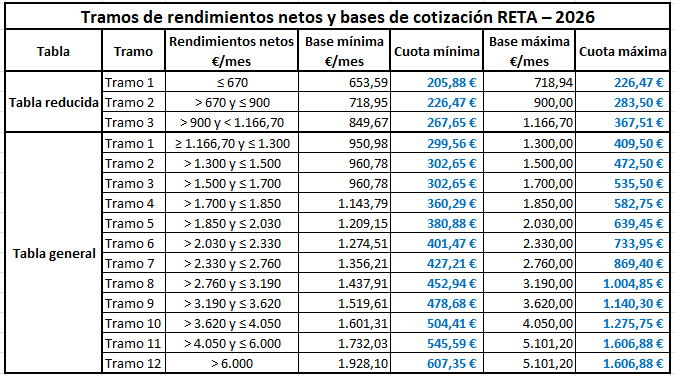
Using the figures from the example (income of €2,204.10), the income bracket from €2,031 to €2,330 would apply, meaning that the contribution could range between €401.47 and €733.95.
Increase in the Minimum Contribution Base for Company Partners under RETA in 2026:
From 2026, company partners registered under RETA (including company directors registered under RETA) will face an important change in their Social Security contributions. The minimum contribution base used to calculate the monthly contribution will increase, affecting the final monthly amount payable.
Minimum contribution base and contribution for 2026
Provisional 2025 contribution base: €1,000, increasing to €1,424.40 for 2026.
Approximate monthly contribution increases from €314 to approximately €448.
Estimated monthly increase: €134.
During 2026, a provisional contribution base of €1,000 may be maintained. However, during the annual regularisation process, the Spanish Social Security Treasury (TGSS) will apply the minimum contribution base of €1,424.40, which may result in an additional amount becoming payable.
Conclusion
The increase in the minimum contribution base results in a direct increase in the monthly contribution and requires company partners to plan their liquidity with the annual regularisation in mind. As the regularisation does not involve interest or surcharges, it may be financially advisable to maintain the provisional contribution and set aside the difference in order to pay the amount due when the subsequent regularisation takes place.
Adjustment and Regularisation of Contributions
Contributions may be adjusted upon request up to six times per year. A final regularisation takes place after the end of the year, in a similar manner to the annual personal income tax assessment.
It should be borne in mind that, unlike advance personal income tax payments, updating the contribution base is voluntary and is based purely on expected income. Once the year has ended and the personal income tax return has been filed, the TGSS carries out the corresponding regularisation and deducts the contributions already paid from the final amount due. If the final income is higher than expected, the difference may be paid without interest or surcharges.
€86 Flat-Rate Contribution (Tarifa Plana) for New RETA Registrations
The flat-rate contribution (Tarifa Plana) is a measure designed to support new self-employed persons and entrepreneurs. It allows eligible individuals to pay a reduced monthly Social Security contribution of approximately €86 for 12 months. Only after these 12 months and any applicable extensions have expired are contributions calculated according to income. To qualify, it is necessary not to have been registered as self-employed during the previous two years.
An extension of the flat-rate contribution may be requested before the initial 12-month period expires if expected income is below the applicable statutory minimum wage. In 2025, the statutory minimum wage amounted to €16,576 per year for full-time employment.
Reduction When Simultaneously Employed
Business owners who are simultaneously self-employed and employed by another employer may choose whether to apply for the flat-rate contribution for self-employed persons (Tarifa Plana) or a reduction in their Social Security contributions. This reduction may apply for up to three years:
- If the person is also employed full-time: a 50% reduction in contributions may be requested for the first 18 months. From months 19 to 36, a 25% reduction may apply.
- If the person is also employed part-time: a 25% reduction may be requested for the first 18 months. From months 19 to 36, a 15% reduction may apply.
Subsidy or Zero Contribution (Cuota Cero)
Some Autonomous Communities (Comunidades Autónomas – CC.AA.) have introduced their own subsidies for newly self-employed persons, consisting of a 100% subsidy of the flat-rate contributions. This subsidy enables new entrepreneurs to effectively bear no Social Security contribution cost during their first year of activity (cuota cero). It may also be available during the second year if their income remains below the statutory minimum wage (Salario Mínimo Interprofesional).
At present, applications for the cuota cero can be made in the following Autonomous Communities: Andalusia, the Balearic Islands, Madrid, Murcia, La Rioja, the Canary Islands, Galicia and Extremadura.
It should, however, be noted that, unlike the flat-rate contribution, each Autonomous Community establishes its own requirements for each subsidy programme. Furthermore, as this is a subsidy, the self-employed person must initially continue paying the Social Security contributions. Once the subsidy has been approved, the Autonomous Community reimburses the contributions paid. A decision on the subsidy application may take between three and six months.
As stated at the beginning, economically active persons who are not required to register under RETA are generally treated as employees and therefore normally fall under the standard employment regime.
 Our Services as Lawyers and Tax Advisors:
We assist you both with professional advice and with registering as self-employed or incorporating your company. We can subsequently represent you before the Spanish Tax Agency as your tax advisors and take care of your bookkeeping, taxes and annual accounts. All important documents and communications can be handled in English.
As lawyers, tax advisors and a registered PAE, our firm will be pleased to assist you in analysing your specific situation, carrying out the necessary administrative procedures and preparing and filing the required tax returns on your behalf. Further information about our services for self-employed persons and business owners can be found in the section Self-Employment.
If you are interested in our services or have specific questions regarding this topic, please do not hesitate to contact us by email or telephone in English.
Author:

Silvia Luque
Director Self-Employed
Accountant & Tax Advisor
info@sspartners.es
Tel: (+34) 951 12 13 06
Facebook I LinkedIn I Amazon
Stay informed! Follow us on:


 (+34)
(+34)