


With regard to the tax treatment of self-employed persons (personal income tax) and companies (corporate income tax), the following tax advantages of companies can be identified in simplified terms. It should be noted from the outset that the incorporation of a company should always be based on genuine business and organisational requirements and not solely on the aim of obtaining a tax advantage.
1. Taking advantage of personal allowances and progressive personal income tax rates.
If, for example, several family members actually work in the business, a self-employed person may employ their spouse, although the salary is subject to the applicable collective bargaining agreements.
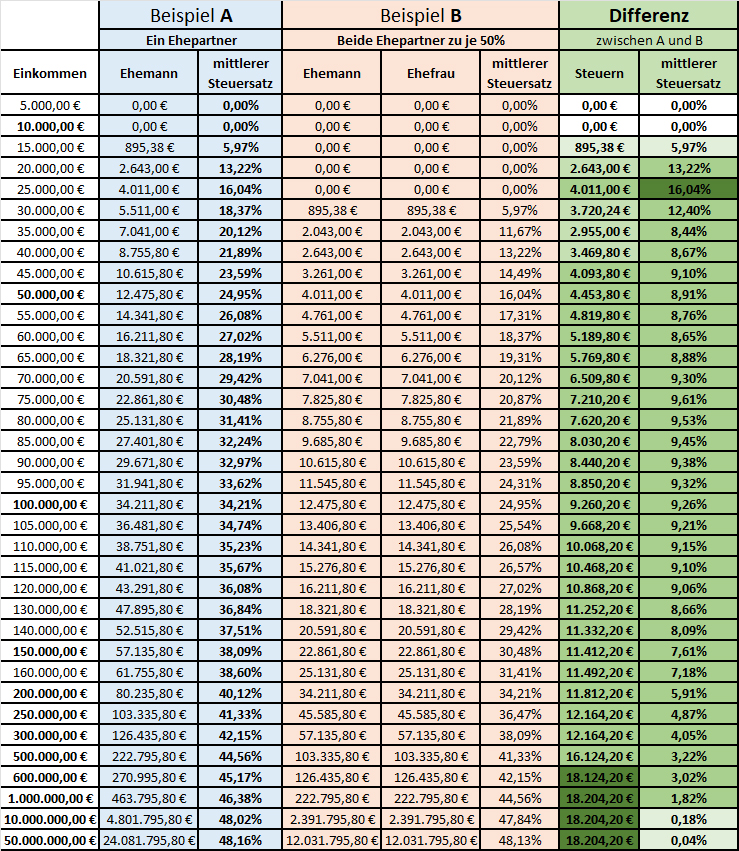
In the following example, the husband is self-employed and his wife, in practice, contributes equally to the business. To simplify the example, it is assumed that although the wife works in the business, she does not formally receive a salary. In this case, the husband would have to declare the entire income for personal income tax purposes, as Spain does not provide for an income-splitting system for married couples comparable to the German "Ehegattensplitting".

If, however, the business is operated through a company and both spouses work equally for their company as equal shareholders, the income could be divided equally between the spouses in the form of salaries. In this case, each spouse would file a separate personal income tax return for half of the income and would therefore benefit from lower progressive tax brackets. The following table, based on actual figures for Andalusia in this example, illustrates how the overall tax burden varies depending on the chosen structure:
2. Taxation under non-progressive corporate income tax.
The second advantage of a company is that its profits are subject to corporate income tax. Corporate income tax is not progressive, meaning that profits are taxed independently of their amount. The standard tax rate is 23%, while a reduced rate of 15% applies for the first two years in which the company generates a positive taxable result.
Shareholders' salaries are generally deductible expenses for the company, meaning that income not paid out as salary is taxed as company profit under corporate income tax. For example, if a self-employed person has taxable income of €120,000, the resulting tax would amount to approximately €43,290 (36%). If, however, a company generates income of €120,000 and decides to pay €60,000 as salary and retain €60,000 as profit within the company, approximately €16,200 in personal income tax and €13,800 (€9,000 during the first two years) in corporate income tax would be payable. In this example, the self-employed person would therefore pay €14,100 more in tax (€18,900 more during the first two years if the 15% corporate income tax rate applies).
It should, of course, be noted that this constitutes a tax optimisation strategy only if part of the income remains within the company. If 100% of the income is paid out as salary and therefore transferred to the shareholders' personal assets, this structure does not result in any actual tax savings.

3. Distribution of dividends and taxation as savings income (base del ahorro) under personal income tax.
A third aspect is the possibility of distributing dividends or investment income to shareholders in proportion to their respective shareholdings in the company's share capital. Shareholders who do not work for the company can therefore receive a return on their investment. From a tax perspective, this type of profit distribution may also be advantageous for working shareholders, as investment income in Spain is subject to only limited progressive taxation (19%–23%). If the shareholders are already subject to high progressive personal income tax rates or even the highest marginal rate, the combination of the reduced corporate income tax rate (15%) and taxation of investment income (19%) can result in a combined tax burden of 34%. In the example from the previous section, if the €60,000 (less €9,000 in corporate income tax) were distributed as dividends to the shareholders, only €10,710 in additional tax would be payable when the dividends are transferred to the shareholders' personal assets. This would result in tax savings of €8,190.
Here too, it should be noted that dividends paid to working shareholders must be proportionate to their salary and to the company's productivity.
4. Improved deductibility of vehicles, real estate and business expenses in general.
Further general tax advantages of companies may include improved deductibility of company cars, business expenses or the rental of properties owned by the shareholders.
Please note that the tax advantages described above should always be based on genuine factual and economic circumstances. Whether taxation through a company can be applied correctly must therefore always be assessed on a case-by-case basis. More detailed information on this issue can be found in our article: Risk of Tax Evasion Through the Improper Use of Companies (S.L.)
Use our legal form self-assessment tool to obtain an initial recommendation when choosing between self-employment and a company.
In our blog "Autónomo or Company" you will find further articles on liability, timeframes, costs, shareholders' residence and other relevant aspects.
Our firm will be pleased to assist you in analysing your specific situation, carrying out the necessary administrative procedures and preparing and filing the relevant tax returns on your behalf. If you are interested in our services or have specific questions regarding this topic, please do not hesitate to contact us by email or telephone.
Author:

Christoph Sander
Lawyer and Tax Advisor
CEO, Partner, Director
info@sspartners.es
Tel: (+34) 951 12 13 06
Facebook I LinkedIn I Amazon
Stay informed! Follow us on:


 (+34)
(+34)